
Saved entities
Typed results stay aligned across browsing, findings, reports, sources and the relationship map.
Product
Start with a focused question, prepare a compatible investigation plan and keep every saved result connected to its source and relationships.
Target
Plan before running
Target type shapes compatibility. Coverage shapes breadth. Planning stays separate from execution.
Enter one authorized public clue. Tigess detects its type and prepares a compatible investigation plan.
Previewing a plan does not contact data sources, start a research run or consume credits.
A prepared plan persists the engine-authored module selection, dependency closure, safety modes, provider configuration gaps and credit estimate. Execution uses that reviewed plan rather than rebuilding a hidden alternative.
Questions answered
The result is useful because its meaning, confidence and source remain available after collection.
Typed results stay aligned across browsing, findings, reports, sources and the relationship map.
Direct observations, candidates and contradictions remain visibly different instead of becoming invented certainty.
Each normalized result can point back to saved source material, provenance and any explicit collection limit.
Build evidence-backed handoffs without losing the identity of the result, relationship or supporting source.
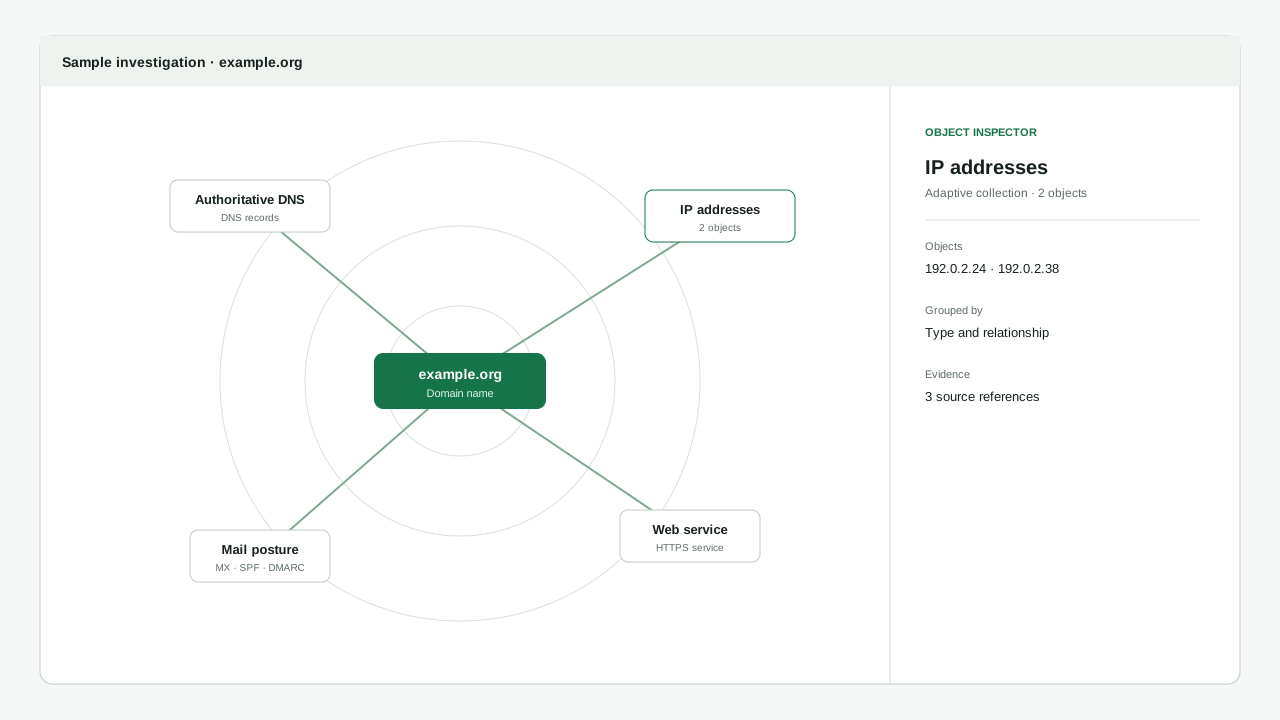
Relationship map
Directly observed context stays close to the starting clue. Candidate, inferred or contradictory context remains visible for review.
Workspace
Keep the operational context around the investigation—not just the final rows.
Keep membership, access, billing context and saved investigations inside explicit account and workspace boundaries.
Use workspace-owned keys and scoped permissions for bounded, repeatable developer workflows.
Summarize saved sources and propose next steps while keeping execution behind a separate confirmation.
See unavailable data sources, useful negative results, errors, limits and progress without hiding partial coverage.
Assisted review
Assistance retrieves saved context for the question and distinguishes observed sources from inference.
Why does the mail-policy finding need review?
A DMARC policy was collected directly, while the candidate mail relationship has only one corroborating source.
The organization may be transitioning policy, but the available sources do not establish intent.
Start with a target
Create an account to plan your first evidence-backed investigation, or talk to us about team and workflow requirements.